
Are We Drifting Apart or Just Tired? Marriage After Kids
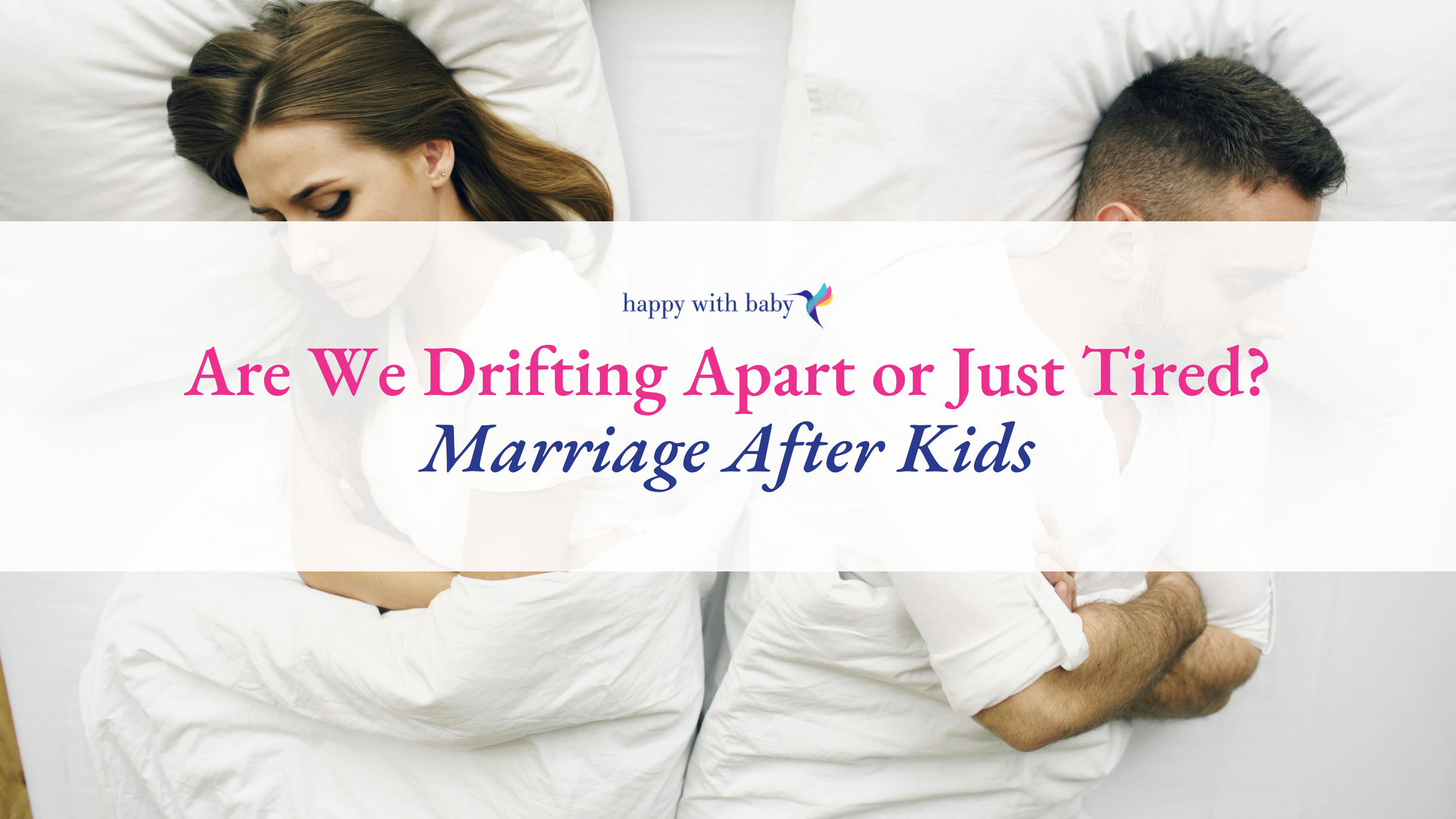
There are seasons in a relationship when everything feels harder than it usually does. You are talking less. You are more irritable with each other. There may be less affection, less sex, less patience, or less interest in having a real conversation once the kids are finally asleep. After enough evenings of sitting beside each other while barely connecting, it can be difficult not to wonder whether something bigger is happening.
Are we actually drifting apart, or are we just really tired?
I think this is one of the scarier questions couples ask themselves because both possibilities can feel true at the same time. You may know that your lives are objectively exhausting while also recognizing that something between you does not feel the way it used to. It is tempting either to catastrophize the distance or dismiss it completely. Neither response is especially useful.
The more helpful question is often not, “Is something wrong with us?” but, “What is this distance telling us?”
Exhaustion Changes How We Experience Each Other
It is difficult to overstate how different a relationship can feel when both people are depleted. When you are running on too little sleep and too much responsibility, patience is usually not the only thing that becomes harder. Curiosity, perspective-taking, emotional regulation, affection, sexual interest, and the ability to let small annoyances go can all take more effort.
I notice this in my own marriage too. There are things my husband does every day that I barely register when I am rested, but when I am exhausted, those exact same things can suddenly feel incredibly irritating. Nothing about him changed. My capacity did. I think that is an important distinction, because sometimes what starts to feel like “a relationship problem” is partly a depleted nervous system reacting to ordinary life.
This matters because couples do not experience exhaustion in isolation. You experience it while trying to parent, work, make decisions, solve problems, and interact with the person who is often standing closest to you. The partner who might normally receive the more generous interpretation of something can begin to feel like one more source of irritation.
A recent systematic review and meta-analysis examined 62 studies involving 43,860 participants and found a moderate association between better couple relationship quality and better overall sleep quality. Greater partner conflict was also associated with poorer sleep quality. Because much of this literature is correlational, the researchers were careful not to claim that one simply causes the other, but the findings reinforce how closely sleep and couple relationships can be connected (Wang et al., 2025).
That helps explain something many couples recognize intuitively. Sometimes after one decent night of sleep, a meal, or a few hours without someone needing something from you, your partner suddenly seems significantly less annoying. Nothing in the marriage changed overnight. Your capacity did.
One Bad Night Can Follow You Into an Argument
Experimental research gives us an even closer look at this connection. Cernadas Curotto and colleagues (2022) randomly assigned 30 couples either to a night of total sleep deprivation or a night of normal sleep. The next day, couples discussed an area of recurring conflict for 15 minutes. The sleep-deprived couples showed higher cortisol during the conflict and less positive affect before and after the discussion than couples who had slept normally.
I do not think this means we can explain every relationship problem by saying everyone needs to go to bed earlier. Parents of babies and young children would probably find that suggestion especially irritating. Sleep deprivation is often not something you can simply decide to stop experiencing.
But it does mean that context matters. If you and your partner are in a season of chronic exhaustion, it is worth remembering that you may be seeing each other through depleted nervous systems. Small problems can feel bigger. Neutral comments can sound sharper. A conflict you might otherwise repair fairly quickly can feel impossible at 10:30 at night when both of you have already reached the end of your capacity.
That does not make the conflict imaginary. It gives you information about the conditions in which it is happening.
The Problem With Saying “We’re Just Tired”
At the same time, I would not want couples to use exhaustion as a reason to ignore what is happening between them. There can always be another reason to postpone paying attention to the relationship. Things will feel better when the baby sleeps through the night. Then after the holidays. Then when work settles down. Then when school starts. Then when soccer season ends.
The trouble is that family life rarely reaches a point when everything suddenly becomes easy. There may be calmer seasons, but there is often something next. Children change. Work changes. Families age. New responsibilities appear.
If “we’re just tired” becomes the explanation for years of feeling disconnected, it may stop being reassuring and start becoming avoidance. The goal is not to decide that every difficult season means your marriage is in trouble. It is to notice whether the relationship is able to recover when there is a little more room.
What Happens When You Finally Have Some Space?
This is one of the questions I find most useful with couples:
When you have even a little more space, do you still move toward each other?
Maybe you finally get an hour without the kids. Do you want to sit beside your partner? If something funny happens, are they still the person you want to tell? When something hurts, do you want comfort from them? If you have had a difficult week, is there some part of you that misses them?
Those are not tests you have to pass. They are simply clues.
Sometimes couples are deeply tired but there is still warmth underneath the exhaustion. They are impatient with each other, but they also miss each other. They argue, but afterward someone reaches back. They are not having enough sex, but affection still feels welcome. They do not have much energy for conversation, but there is still genuine interest in one another when the opportunity appears.
That relationship may need attention, but the distance may be more about limited capacity than a loss of connection.
When the Distance Feels Different
There are other times when couples notice something more persistent. They finally have time together and neither person seems interested in using it together. They stop sharing things because they no longer expect the other person to care. Conflict does not end with reconnection but stretches into silence, withdrawal, or resentment.
Sometimes there is increasing guardedness. A partner makes a small mistake and it is immediately interpreted as evidence of something much larger: You never care. You are always selfish. I cannot count on you. Or contempt begins creeping into the way partners speak to or about one another.
None of those things automatically means the relationship cannot recover. They do suggest that the distance deserves more attention than simply waiting for everyone to feel less tired. The distinction matters because a difficult season and a damaged relationship are not the same thing. But a difficult season can still affect a relationship if it continues without repair.
Repair Matters More Than Never Getting It Wrong
Every couple disconnects. You will both have moments when you are impatient, defensive, sarcastic, distracted, or simply too tired to be your best selves. The question is not whether those moments happen. The question is what happens afterward.
Can one of you come back and say, “That did not come out the way I meant it”? Can you apologize, soften, or let your partner know that you understand why something hurt? Can you reach toward each other again even when the conversation did not go particularly well?
Parsons and colleagues (2020) examined what couples did after conflicts and identified several patterns, including active repair, gaining a new perspective, avoidance, and letting go. In their diary study of cohabiting couples, active repair and gaining a new perspective predicted better emotional recovery after conflict, while avoidance predicted poorer recovery.
That finding fits with what I see clinically. Healthy relationships are not relationships where nobody gets upset or says the wrong thing. They are relationships where disconnection is not always the end of the story. There is some way back.
A Hard Season Can Still Need Attention
One thing that can make this conversation confusing is the idea that if the problem is “just” exhaustion, then nothing needs to change. I do not think that is true. A relationship can be fundamentally solid and still need care during a demanding season, especially when so much else is competing for the couple’s attention.
Simpson and Rholes (2008) reviewed research on attachment, perceived partner support, and the transition to parenthood. Their work emphasized that couples do not all experience the transition in the same way and that vulnerability depends partly on factors such as attachment and perceived support. Their own research also found that some women who entered parenthood with greater attachment anxiety and lower perceived spousal support were particularly vulnerable to declines in marital satisfaction.
That nuance matters. Parenthood does not inevitably damage a relationship. But major transitions can place considerable stress on couples, and some relationships or individuals are more vulnerable than others.
Sometimes noticing distance early is a protective thing. You are paying attention before you have stopped caring.
Questions That May Tell You More Than “Are We Okay?”
If you have been wondering whether you are drifting apart, I would resist the urge to make a quick judgment. Instead, pay attention to patterns.
A Few Questions to Consider
When we have some breathing room, do we naturally move toward each other or away?
Do I still feel warmth toward my partner underneath the irritation?
When something important happens, do I still want to tell them?
Do we repair after conflict, or do hurts accumulate without resolution?
Have I stopped being curious about what my partner thinks and feels?
Do I feel emotionally safe enough to be honest with them?
Is there resentment or hurt between us that we keep postponing?
When did I first notice this distance, and what else was happening in our lives at that time?
You do not have to answer every question positively to have a good relationship. You also do not need to turn these into a scorecard. They are meant to help you become more precise about what you are actually experiencing.
There is an enormous difference between “We are depleted and have not had enough room for each other lately” and “We have stopped trying to reach each other.”
You Do Not Have to Decide What It Means Today
I think one of the hardest things about feeling disconnected is the pressure to interpret it immediately. If I feel distant, does that mean we are unhappy? If we are unhappy, does that mean something is wrong? If something is wrong, what does that say about our future?
That is a lot of meaning to place on a season when you may simply be exhausted and overwhelmed.
You can notice that something feels different without immediately deciding what it means about your marriage. You can also take it seriously without panicking.
Maybe the distance is asking for more rest. Maybe it is asking for a conversation. Maybe there is hurt that needs to be repaired. Maybe the two of you have spent so long caring for everyone else that you have stopped checking in with each other. Or maybe you have been telling yourselves for a long time that things will eventually get better, and it is time to stop waiting.
Curiosity usually gives you more useful information than fear.
When It May Be Time to Get Help
You do not have to wait until a relationship is in crisis to consider couples therapy. If the same conflicts keep happening without repair, if resentment is becoming harder to move through, if there is growing contempt or emotional withdrawal, or if one or both of you no longer know how to reach the other person, getting support earlier can make a difference.
Therapy is not an admission that the relationship has failed. Sometimes it is simply a place to slow down enough to understand what has happened before the distance becomes entrenched. The same is true if you are not sure whether the issue is exhaustion or something deeper. You do not need to figure that out perfectly before asking for help.
Maybe the Better Question Is Whether You Can Still Find Each Other
There are seasons when marriage after kids can feel very far from the relationship you imagined. You may both be tired. You may be less patient. You may not be having the conversations, sex, or time together that you wish you were having.
That does not automatically mean you are drifting apart. But the answer is not simply to reassure yourself that everything is fine either.
Instead, notice whether there is still movement toward each other. Do you repair? Do you care how the other person is doing? Do you miss each other? Can you still find moments when you remember why you chose this person? And when things have been hard, can you eventually come back?
Maybe the question is not just, “Are we drifting apart or are we tired?”
Maybe it is:
Even when life pulls us apart for a while, can we still find our way back toward each other?
That is a question worth paying attention to.
Watch the Video
Are We Drifting Apart or Just Tired? Marriage After Kids
If you are realizing that you and your partner have been feeling distant for a while, you may also want to watch:
How to Reconnect With Your Partner After Kids (When You Feel Distant & Exhausted)
You can also watch the earlier videos in this series:
Feeling Like Roommates After Kids? Why It Happens
When Did We Stop Having Fun Together? Marriage After Kids
If You Want Support
If you and your partner still care deeply about each other but feel increasingly distant, you do not have to wait until the relationship reaches a breaking point to get support.
I work with couples in Sacramento and throughout California via telehealth who want to understand what has happened between them, communicate differently, repair lingering hurts, and feel more connected while navigating the demands of family life.
I offer free consultations if you would like to see whether working together might be a good fit.
References
Cernadas Curotto, P., Sterpenich, V., Sander, D., Favez, N., Rimmele, U., & Klimecki, O. (2022). Quarreling after a sleepless night: Preliminary evidence of the impact of sleep deprivation on interpersonal conflict. Affective Science, 3(2), 341–352. https://doi.org/10.1007/s42761-021-00076-4
Parsons, J. A., Prager, K. J., Wu, S., Poucher, J. W., Hansen, M. P., & Shirvani, F. (2020). How to kiss and make-up (or not!): Postconflict behavior and affective recovery from conflict. Journal of Family Psychology, 34(1), 35–45. https://doi.org/10.1037/fam0000579
Simpson, J. A., & Rholes, W. S. (2008). Attachment, perceived support, and the transition to parenthood: Social policy and health implications. Social Issues and Policy Review, 2(1), 37–63. https://doi.org/10.1111/j.1751-2409.2008.00010.x
Wang, X. X., Lin, Q., Liu, X., Dong, P., Bao, Y., Que, J.-Y., Lu, L., Wei, Y. B., & Liu, J. J. (2025). The association between couple relationships and sleep: A systematic review and meta-analysis. Sleep Medicine Reviews, 79, 102018. https://doi.org/10.1016/j.smrv.2024.102018
About Catherine O’Brien
Catherine O’Brien is a licensed marriage and family therapist in Sacramento, California, and the author of Happy With Baby: Essential Relationship Advice When Partners Become Parents. She specializes in helping couples and parents navigate the relationship changes that come with raising a family and works with clients in Sacramento and throughout California via telehealth.
Learn more or schedule a free consultation at HappyWithBaby.com.